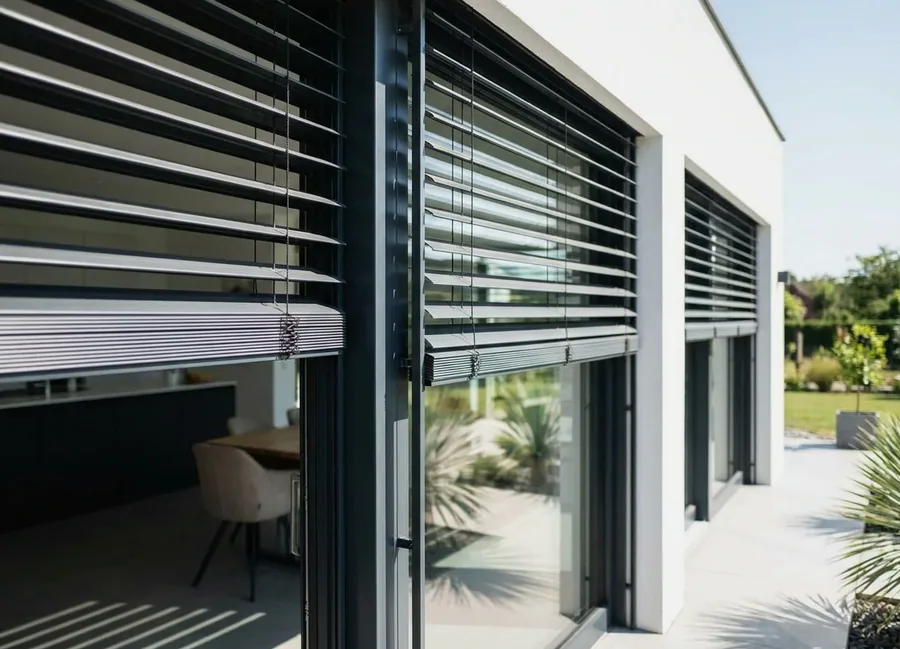
An interior blind manages heat that's already in the room. An exterior one intercepts it at the glass, before it ever becomes the room's problem. On the hard north- and west-facing elevations that define most of the ridge, that difference is the whole argument — this is how architects shade genuinely glass-heavy buildings, here and internationally.
The product itself is wide aluminium slats — usually in the 60–90mm class — running in guided side rails or cables, tilting and raising like an interior venetian but built and finished for weather exposure. Powder-coated finishes are engineered to stay outside permanently.
Waterkloof Ridge is exactly the elevation this product was built for.
External venetians are effectively always motorised, and always paired with a wind sensor that retracts them automatically before a gust or a highveld storm can damage the system. That's not an upsell — it's how an exterior product protects the investment. Retrofit is possible on a suitable elevation, but the cleanest results come from involving us at the design or renovation stage, so fixing points and cable runs are planned rather than improvised.
Practical notes
- Best suited to hard north- and west-facing glass, and to architect renovations planning aesthetics-committee-friendly clean lines.
- Effectively always motorised, with wind-sensor auto-retract as standard practice, not an optional extra.
- Facade fixing points matter — a site visit and, ideally, design-stage involvement give the cleanest result.
- Premium spend, positioned as a building improvement rather than window dressing.